
As an Amazon Associate I earn from qualifying purchases. A turntable is useful only if it fits the cabinet and can rotate without catching the door or nearby items. For a rectangular model, measure the full footprint and movement path before buying.
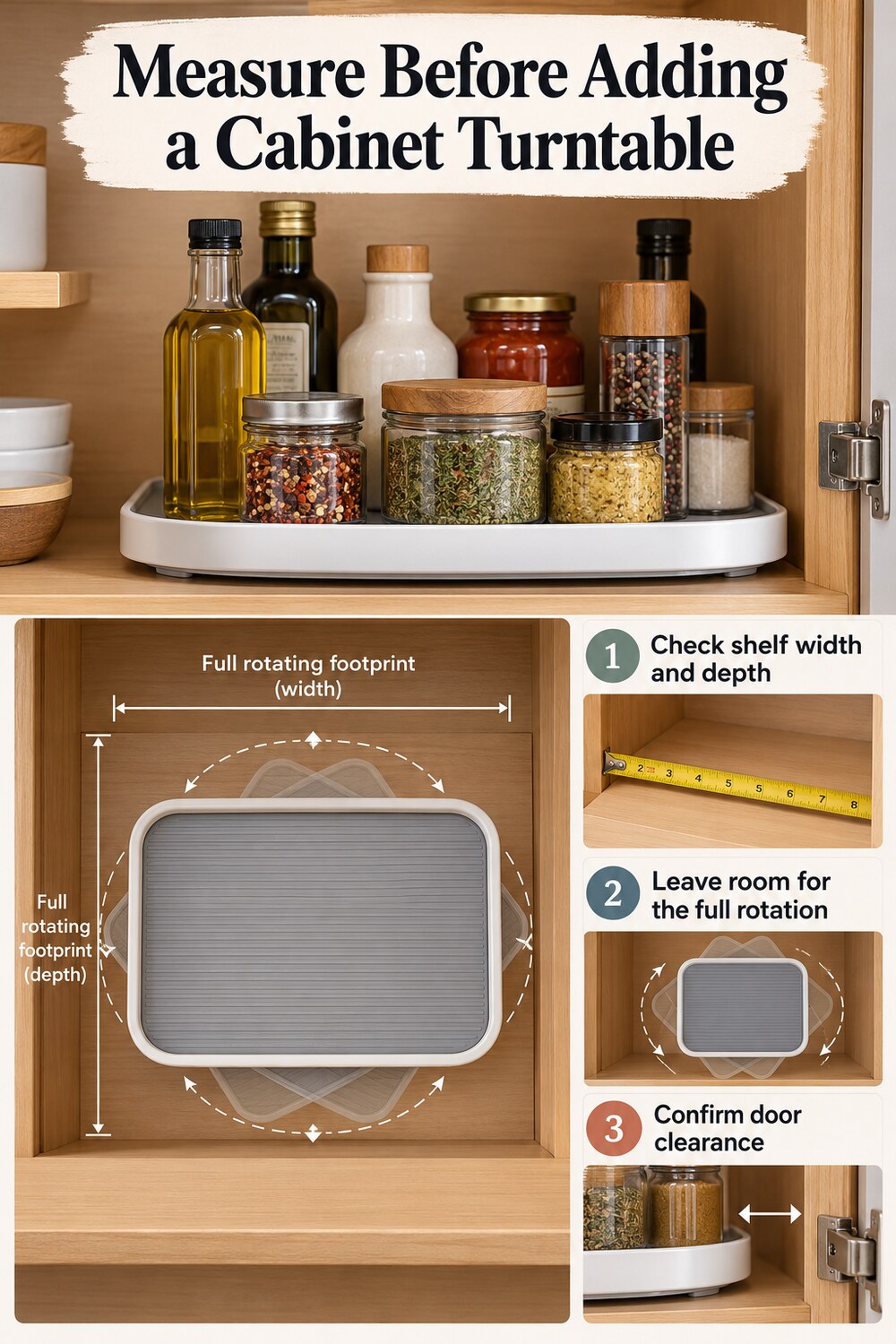
Measure shelf width and depth
Measure the shelf itself, then note any hinges, lips or supports that reduce the usable area. Check the current product listing for the turntable’s outside dimensions. Leave room to reach it and to remove items from the shelf; don’t treat the shelf’s full nominal size as available space.
Test the rotation and door clearance
Use a box or paper template the same size as the listed base. Place it on the shelf and mimic the full turn. Open and close the cabinet door while checking for contact with the frame, hinges and neighboring containers. The organizer needs clearance while moving, not only when sitting still.
Plan what belongs on it
Group a few frequently used items that fit within the organizer’s surface and any stated load guidance. Avoid stacking items so high or tightly that they tip when the turntable moves. Keep heavy glass containers low and within easy reach, and use a stable shelf.
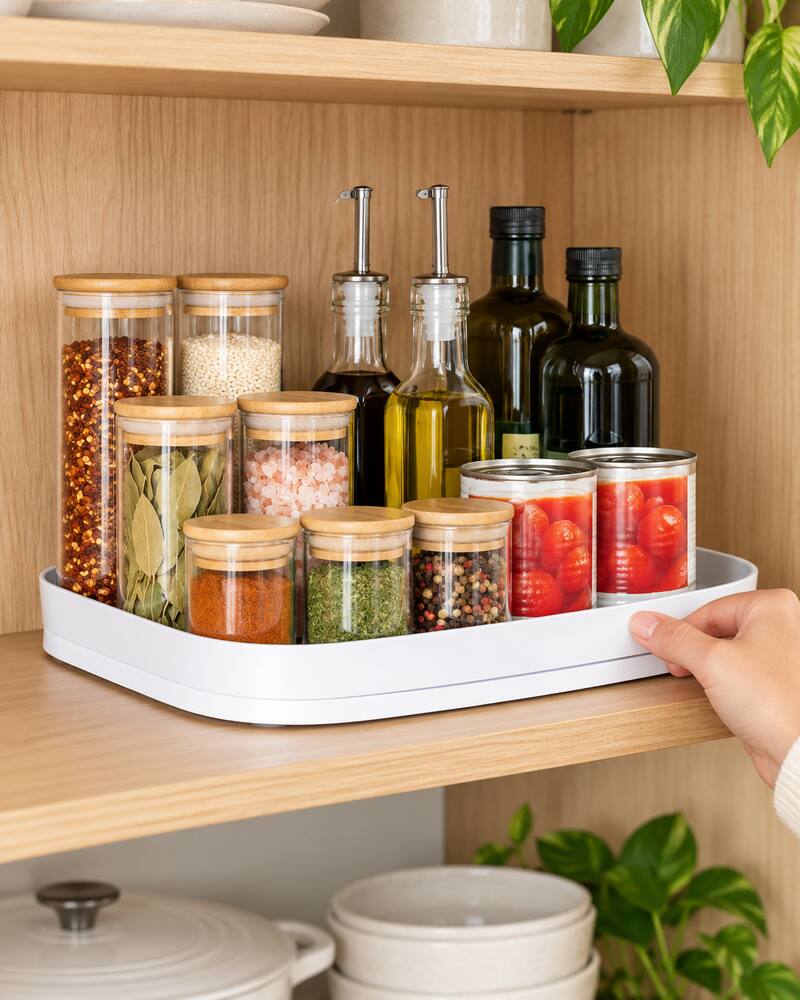
What this product may help with
It may bring frequently used items forward in a cabinet. Verify the listed footprint, full rotation, door clearance and shelf stability before deciding it fits.
Product featured in this guide
The product example is the YouCopia MagicTrack Rectangle Turntable (ASIN B0FQXRMSBD). Check the live listing for current dimensions, care and use instructions, then compare it with your paper-template test.
Fit test
- Measure usable shelf width and depth
- Check the listed base dimensions
- Leave clearance for a complete rotation and open door
- Keep the planned items within the product’s stated use guidance
Cabinet dimensions and hinge placement vary. Measure your own shelf and verify the listing before deciding whether the turntable is a fit.
Measure the cabinet step by step
- Door opening: measure the narrowest width the turntable must pass through, not the cabinet’s inside width.
- Shelf depth: measure from the back wall to the inside of the door, with the door closed.
- Height: measure from the shelf to the next shelf or the ceiling of the cabinet. Tall bottles need extra room.
- Obstacles: check for hinges, pipes or a center post that could catch the rim as it turns.
How much clearance a turntable needs
A round turntable turns in a circle, so the diameter has to fit inside the cabinet with a small gap all around. Leave about half an inch to an inch between the edge and the walls. Remember that items on the edge stick out past the tray, so a tall jar can hit the door frame even when the empty tray fits.
Which items work well
Turntables suit small bottles, spice jars, oils, sauces and canned goods. They work poorly with very heavy pots, items taller than the shelf clearance, and anything that would spill. Put the heaviest things near the center and the lightest at the edge so the tray spins smoothly.
Tips for a smoother setup
- Use a non-slip liner on the tray so items do not slide when it spins.
- Group by use, for example baking items on one tray and oils on another.
- Spin it with the door open before loading to check nothing catches.
- Wipe up spills right away, because sticky residue slows the bearing.
When a turntable is not the best choice
In a narrow cabinet or a cabinet with a center post, a turntable will not rotate fully. A pull-out shelf, a stackable riser or a small bin may serve you better. Measure first, and choose based on the shape of the cabinet, not only the product photo.
Common mistakes with cabinet turntables
- Measuring the shelf but not the door. A turntable can fit the shelf and still jam if the door hinge or a face-frame edge sits in the swing path. Spin it with the door open and closed.
- Ignoring item height. Tall bottles on the outer edge stick out higher than the shelf above, so measure your tallest bottle plus the turntable’s own height.
- Overloading one side. A heavy jar placed at the rim puts more strain on the bearing than the same jar near the center. Put heavy items in the middle and lighter ones outside.
- Skipping a trial with real items. Load it with what you actually own before deciding. Many people find that two small turntables work better than one large one.
Troubleshooting a turntable that sticks or wobbles
If the surface does not turn smoothly, first check that the base sits flat on the shelf and is not catching on a raised lip or shelf pin. Wipe away dust or sticky residue under the turntable, since spilled oil or syrup can slow the bearing. A wobble usually comes from an uneven shelf or items stacked unevenly, so redistribute the load before assuming the product is faulty. If it still catches, compare the rim to the cabinet opening: a turntable that is slightly too wide will rub at the edges even when the center fits.
Care and cleaning
Wipe the surface with a damp cloth and mild soap, and dry it completely so moisture does not sit under the base. Do not soak it unless the manufacturer’s instructions say it is safe. Take everything off every few months and clean the cabinet shelf as well.
Quick questions
Does a turntable make a corner cabinet more useful?
Often, yes, because items from the back come around to the front instead of being lost. It helps most with small jars, spices and bottles. For bulky pots, a pull-out shelf may suit you better.
Will it scratch my shelf?
Hard plastic or metal feet can mark softer finishes. If your shelf is delicate, check whether the product has non-slip pads or add a thin liner underneath.
Updated October 29, 2026. Zoventaq’s guides are desk research and are not based on hands-on testing.