

The narrow gap beside a refrigerator or the seam where a backsplash meets the counter can collect crumbs long before a regular sponge reaches it. Buying a tool with the thinnest-looking head is not automatically the answer: its handle may be too short, or its shape may not suit the angle. Start with the gap and the kind of debris you need to remove.
Check the gap and the angle
Estimate the width and depth of the space, then note whether you can approach it from above, from the side, or only at an angle. A narrow brush head may suit a seam, while a flexible cloth can be more adaptable around a faucet base. Compare both head dimensions and handle length with the actual area, rather than relying on a product’s general description.
Consider what needs removing
Dry crumbs and loose dust may lift with a soft brush or a vacuum attachment that fits the opening; sticky residue may call for a damp cloth and the surface-appropriate cleaner. Bristle stiffness and head shape are useful criteria to compare, but the right choice depends on the surface and the mess. Follow cleaner labels and never mix cleaning products.
Make cleanup part of the choice
A tool that cannot be rinsed or dried easily can become one more awkward item under the sink. Check whether the head detaches, whether the handle stores safely, and whether the tool’s care instructions suit your routine. Zoventaq’s recommendations are research-based, not hands-on tested; affiliate links in a guide may earn us a commission.
Choose the least awkward tool for the opening
Loose dry crumbs: Try a soft brush or suitable vacuum crevice attachment. Check the vacuum instructions before approaching moisture. A reachable seam: A cloth folded around your fingertip may be easier to control than a brush. A deep narrow gap: Compare the entire tool profile, including the neck and handle, with the opening. A thin head is not useful if its handle stops it reaching the debris. A delicate finish: Follow the surface maker’s instructions rather than assuming a stiff brush is safe.
A repeatable corner-cleaning sequence
First remove nearby movable items so you can see the full area. Lift loose debris before adding moisture. Test the permitted tool and cleaner on a hidden part of the same finish, then work gently from the accessible edge. Wipe away loosened material rather than pushing it farther into the gap. Dry the area as its care instructions require and clean the tool before storing it.
Stop if reaching the gap means opening appliance panels, disturbing wiring, or moving gas-connected equipment. Consult the appliance’s maintenance instructions or a qualified service provider. A household detail brush is not a reason to reach into inaccessible machinery.
Buying checks that matter more than a large accessory kit
Record the head width, usable reach, approach angle, and storage space you need. Check how a replacement head attaches and whether replacements are sold for that exact model. For a powered tool, verify water-exposure limits and cleaning instructions. More attachments add storage and cleaning work; choose the shape needed for a repeated task rather than buying solely by piece count.
Pinterest product example: detail cleaning tool
The Rubbermaid Reveal Power Scrubber 18-Piece Kit (ASIN B08D6T4DKS) is an example for small-detail cleaning around compatible surfaces. A powered brush may reduce repetitive hand scrubbing, but use depends on surface finish and the maker’s directions.
Check the current listing for included heads, power requirements and care. Test an inconspicuous area when surface guidance recommends it, keep the brush away from delicate finishes and do not treat it as a guarantee of a stain-free result.
Order of cleaning matters
Dust first, then wipe, then scrub. Removing loose crumbs and dust before adding moisture avoids smearing grime into a paste. Work from top to bottom so falling debris lands on surfaces you have not cleaned yet.
Protecting surfaces and keeping safe
- Test any brush on a hidden spot to be sure it will not scratch the finish.
- Unplug appliances and let them cool before cleaning behind or beside them.
- Avoid mixing cleaning products, and follow label directions for ventilation.
- Do not push sharp or metal tools into slots near electrical parts.
Caring for microfiber and brush heads
Wash microfiber cloths and covers separately from towels and skip fabric softener, which can leave a coating that reduces absorbency. Rinse brush heads after use and let them dry fully so they do not hold dampness. Replace a head when it frays or stops picking up grime.
Updated October 30, 2026. Zoventaq’s guides are desk research and are not based on hands-on testing.
Frequently asked questions
Does a powered brush disinfect? Mechanical scrubbing does not establish disinfection. If disinfection is needed, follow an appropriate product’s label, including surface compatibility and contact time. Never mix cleaning products.
Can I use the same brush everywhere? Keep tools for toilets and floors separate from those used around food preparation. Label similar-looking tools so they are not confused.
What if the tool still will not fit? Do not force it or substitute a sharp object that could damage the surface. Recheck access from a different safe angle and consult the item’s maintenance instructions.
See our cleaning-tool selection guide and under-sink storage checks. As an Amazon Associate I earn from qualifying purchases.

- 【Stiff Bristle】Thick stiff bristles dig into curves, edges and crevices of toilet bowls and bathroom surfaces, deliverin…
- 【15.16″-45.28″ Extendable】Telescopic stainless steel handle adjusts between 15.16 inches and 45.28 inches, easily reachi…
- 【Curved Brush Head Design】The curved brush head fits perfectly with toilet bowl contours. It covers wider areas with eve…
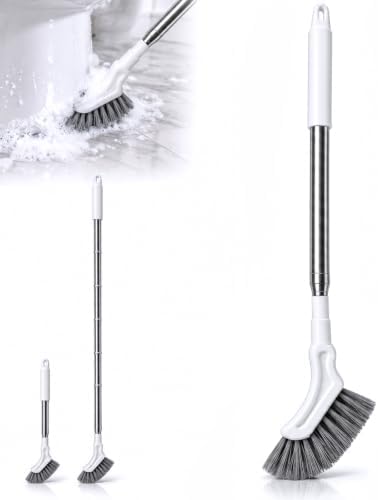
- ADJUSTABLE TELESCOPIC HANDLE: This shower cleaning brush features an extendable stainless steel handle that adjusts from…
- STIFF BRISTLES FOR DEEP CLEANING: Designed with dense, firm bristles, this bathroom scrub brush helps remove stubborn di…
- ANGLED BRUSH HEAD FOR TIGHT SPACES: The specially angled brush head makes it easier to clean hard-to-reach areas, includ…

- 【38.5–115 cm Telescopic Handle】 Adjust the stainless steel handle from 15.16 to 45.28 in for floors, walls and low areas…
- 【Curved Stiff-Bristle Head】 Dense bristles and a slim curved profile help scrub along edges, corners, grout lines and na…
- 【Slim 10.2 × 2 cm Brush Head】 The compact brush head reaches spaces where wider floor brushes may not fit. Use it for ti…